


In partnership with

Hang in there, it’s almost Friday, folks!
Generative engine optimization has spent a year as a slide. A workshop. A thing an agency offers between the podcast strategy and the influencer tier list.
Then somebody signed.
The Estée Lauder Companies entered a global partnership with Profound to track and improve how its brands are represented across ChatGPT, Gemini and other generative platforms, Chain Drug Review reported on Monday. The company says it is the first prestige beauty company to deploy this globally across its full portfolio: product pages, blogs and YouTube channels reshaped so a model can read the ingredients, claims and benefits without guessing.
"The way people discover beauty is being rewritten in real time, and we intend to shape that shift rather than reacting to it," said Aude Gandon, the group's global chief digital and marketing officer.
Two things to take from it, neither of them the vendor. They bought rather than built, which is the right call for a capability nobody has owned for more than eighteen months. And they did it portfolio-wide, because running GEO on one brand teaches you almost nothing when the model is comparing you with your own stablemates in the same answer.
The pitch you get next quarter will be identical minus the scale. Ask what changes on your actual pages, and who is accountable when the model still gets your claims wrong in six months.
Today’s sponsor:
Blu Dot surpasses 2,000% ROAS with self-serve CTV ads

Home furniture brand Blu Dot blew up on CTV with help from Roku Ads Manager. Here’s how:
After a test campaign reached 211,000 households and achieved 1,010% ROAS, the brand went all in to promote its annual sales event. It removed age and income constraints to expand reach and shifted budget to custom audiences and retargeting, where intent was strongest.
The results speak for themselves. As Blu Dot increased their investment by 10x, ROAS jumped to 2,308% and more page-view conversions surpassed 50,000.
“For CTV campaigns, Roku has been a top performer,” said Claire Folkestad, Paid Media Strategist, Blu Dot. “Comping to our other platforms, we have seen really strong ROAS… and highly efficient CPMs, lower than any other CTV partner we've worked with.”
Using Roku Ads Manager, the campaign moved from a pilot to a permanent performance engine for the brand.
TALK ON THE MARKET
Ethan Mollick of Wharton, on Sunday night:
Read the conditions, not the claim. Properly guided and harnessed is carrying that whole sentence, and it is the part nobody is selling. The models arrived. The guiding is a management problem, and it is yours.
Want to see case studies of AI-powered campaigns?
Try our sister newsletter:

NUMBERS MATTER
62%. Sixty-two percent of in-house marketers say leaders outside marketing still judge them on traditional SEO metrics or web traffic, in a survey of 602 US marketing and PR professionals by Scrunch and Scribewise, reported by Newsweek.
Fifty-six percent cannot distinguish AI search optimization from ordinary SEO, and only about a third analyze AI bot traffic at all.
DAILY PROMPT
Models quote definitions and most brands have never written one. The full SEO Glossary Page Writer from the hub, which is the page a model repeats:
You are an SEO content strategist writing glossary pages for [WEBSITE/BRAND]. Your goal is to create search-optimized definitions that rank for long-tail keywords while establishing topical authority. Work the task end to end: read the files I attach, research what currently ranks for the term, then draft.

## Page Parameters
- Target term: [GLOSSARY_TERM]
- Primary keyword: [PRIMARY_KEYWORD]
- Related keywords to naturally incorporate: [RELATED_KEYWORDS]
- Target audience: [AUDIENCE_LEVEL: beginners/intermediate/advanced]
- Industry/niche: [INDUSTRY]
- Tone: [TONE: professional/conversational/technical]
- Attached context: [STYLE_GUIDE_FILE], [EXISTING_GLOSSARY_URLS], [KEYWORD_EXPORT_FILE]

## Research Step
Before drafting, search for the target term and review the pages that currently occupy the top results and the featured snippet. Note the angles they take, the subtopics they cover, and the questions they leave unanswered. Summarize the gap you intend to fill in two or three lines, then write the page against that gap.

## Content Structure
Write a glossary page with these sections:

### Definition (100-150 words)
Provide a clear, jargon-free definition in the first sentence. Explain what the term means, why it matters, and who uses it. Avoid circular definitions.

### Why It Matters (75-100 words)
Explain the business or practical impact. Connect to real workflows or outcomes. Answer: "Why should someone care about this term?"

### Key Components or Characteristics (100-150 words)
Break down 3-4 core elements or features. Use bullet points for scannability. Include context on how these components work together.

### Common Use Cases (100-150 words)
Provide 2-3 realistic scenarios where this term applies. Make examples specific to [INDUSTRY]. Show how professionals use this concept in practice.

### Related Terms (50 words)
List 3-5 related glossary terms with brief explanations. Match them against [EXISTING_GLOSSARY_URLS] and flag which ones already exist as internal links and which are content gaps.

## SEO Requirements
- Include primary keyword in H1 and first 100 words
- Use related keywords naturally, never forced
- Write for featured snippet capture: direct, scannable answers
- Target word count: 500-700 words
- Use active voice and short sentences
- Add one relevant example or analogy

## Output Format
Provide the complete glossary page in markdown, ready to publish, followed by a short list of the research sources you used and any claims I should verify against our own data.
Do this for your five highest-margin categories. It is the cheapest GEO work there is, and it survives the next model update because it is just true.
CMO CORNER
If your presence is the only source of clarity, you're not leading. You're babysitting.
Same failure, different object. If the only place your brand is described accurately is the site you control, a model has nothing to triangulate and you are back in the room explaining yourself. Estée Lauder is paying to be described consistently everywhere a machine looks. Build the thing that speaks when you are not there, then stop being the source.
We provide consulting services for CMOs on AI strategy for marketing teams through our Teamless offering.

TOOL UPGRADE
Three tools for producing the material a model actually quotes:
Rytr — best for getting definitional, claim-level copy drafted at volume without a new headcount. Try Rytr here →
Podsqueeze — best for turning the audio you already made into text and transcripts a model can index. Try Podsqueeze here →
Testimonial.to — best for collecting the third-party proof that shows up when the answer cites someone other than you. Try Testimonial.to here →
→ We have 300+ curated, filtered, and categorized AI tools in our directory. Browse to find the best ones that help your marketing team.

LEARN THIS
If you are starting this conversation later than Estée Lauder, start with the sequence rather than the tactics: AI Roadmap 101.
It lays out what to do first, what to leave until the basics hold, and how to tell a real capability from a pilot that will quietly die. For the leader handed a budget, a deadline and no order of operations.
→ We publish workshops, courses, guides, manuals, and more on AI marketing for free. Browse our learning resources for free.
BRAND SLOP
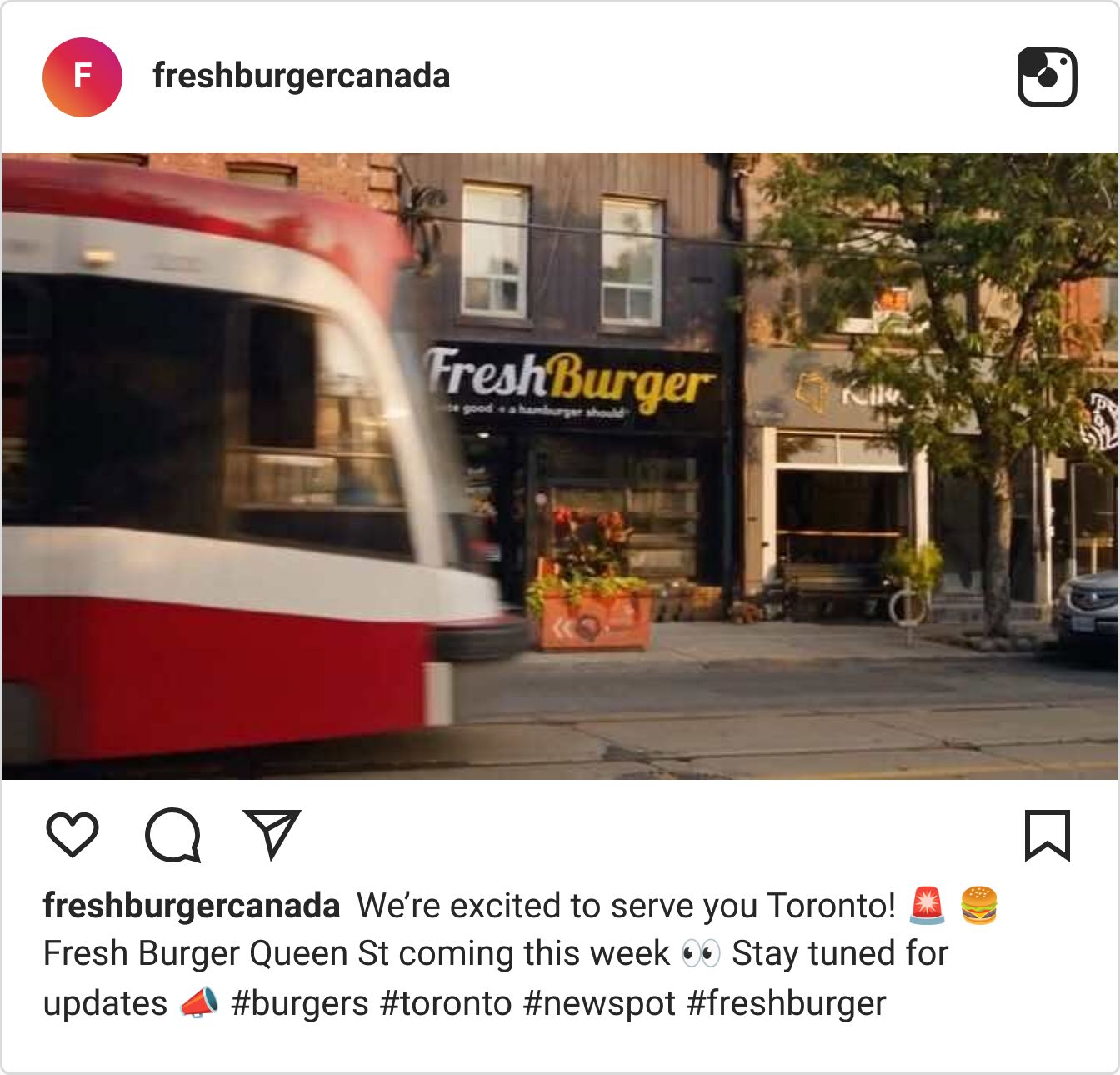
Fresh Burger announced its tenth Toronto-area location with an AI-generated video, and blogTO reported what happened next. Locals clocked that the streetcar in the shot is a model that does not exist. Commenters pointed out the same footage could have been filmed outside the store on a phone in fifteen seconds. The company declined to comment.
The failure is not the video. It is that a generated Toronto street was shown to Torontonians, who know what their street looks like.
Whatever you generate, somebody in the audience is the world expert on the detail you did not check.