


In partnership with

Hang in there, it’s almost Friday, folks!
Every marketing review this year had a slide with engagement numbers. Traffic up. Downloads up. Influenced pipeline, a figure nobody in finance believes and nobody in marketing can stop reporting.
Forrester's Ross Graber wrote this week that those numbers became proxies for marketing's contribution because they were what could be measured. "That assumption was always incomplete." What changed is that AI search now answers the buyer's question without the visit, so the proxy has lost the click that made it look like evidence.
His replacement is not a better dashboard. He calls it return on objectives. Start from the specific business obstacle, low problem awareness, a competitor buyers prefer, a category nobody has named, and derive marketing's objective from that. Measure against the obstacle, not total engagement. One organization he cites has already dropped sourced-pipeline goals in favor of objectives tied to "visibility and credibility in AI search experiences."
He also warns that goals built on visits, form fills and lead volume "may increasingly encourage behaviors that conflict with visibility in AI-powered environments." Which is a polite way of saying the number you are paid on is now working against you.
Today’s sponsor:
Stop asking clients for LinkedIn passwords

Your agency should not need a founder’s or seller’s personal LinkedIn account to launch a client campaign.
Aimfox Avatars allows you to rent dedicated, customizable profiles for client outreach, all managed inside the same platform.
Launch more campaigns, keep client access separate, and hand interested replies to the right person.
TALK ON THE MARKET
Scott Brinker, who has charted the martech landscape for fifteen years, on Thursday:
Then the line: "You can vibe code a feature. You can't vibe code a brand."
Graber's argument in nine words. The things that move a buyer, preference, credibility, being the name that comes up, are objectives, not outputs. No amount of generated engagement adds up to them.
NUMBERS MATTER
24%. The share of holiday shoppers who plan to begin product discovery with an AI tool such as Gemini, ChatGPT or Claude, up from 17% last year, per Bain & Company as reported by Retail Dive.
Deloitte, in the same piece, expects holiday e-commerce to grow up to 8.4%, helped by "consumers' ongoing use of digital tools." One shopper in four starts somewhere your analytics cannot see.
DAILY PROMPT
I need help selecting the right KPIs for my marketing strategy. Please create a comprehensive KPI framework tailored to my situation.

## Business Context
- Industry: [YOUR INDUSTRY]
- Business Model: [B2B/B2C/Hybrid]
- Primary Revenue Driver: [e.g., subscription, one-time purchase, licensing]
- Company Stage: [Startup/Growth/Mature]
- Annual Marketing Budget: [BUDGET RANGE]

## Marketing Objectives
Rank these by priority (1-5, with 1 being highest):
- Brand Awareness: [RANK]
- Lead Generation: [RANK]
- Customer Acquisition: [RANK]
- Customer Retention: [RANK]
- Revenue Growth: [RANK]

## Current Channels
List the primary marketing channels you use: [e.g., paid search, social media, email, content marketing, events]

## Constraints
- Reporting Frequency: [Daily/Weekly/Monthly]
- Available Tools: [e.g., Google Analytics, HubSpot, Salesforce]
- Team Size: [NUMBER OF PEOPLE]
- Data Integration Capability: [Basic/Intermediate/Advanced]

## Your Task
Based on this context, please:

1. **Recommend 8-12 core KPIs** that directly align with our top 3 objectives. For each KPI, provide:
   - Clear definition and calculation method
   - Industry benchmark range
   - Recommended measurement frequency
   - Why this KPI matters for our specific situation

2. **Create a KPI Dashboard Structure** showing:
   - Which KPIs to track daily vs. weekly vs. monthly
   - Recommended visualization types
   - Threshold alerts (red/yellow/green ranges)
   - How KPIs connect to revenue impact

3. **Identify Leading vs. Lagging Indicators**:
   - Which KPIs predict future performance
   - Which confirm past results
   - How to use both for strategic decisions

4. **Provide Implementation Roadmap**:
   - Quick wins (KPIs implementable in 2 weeks)
   - Medium-term additions (1-3 months)
   - Advanced metrics (3+ months)
   - Required tool integrations or data sources

5. **Flag Potential Pitfalls**:
   - Common mistakes when tracking these KPIs
   - How to avoid vanity metrics
   - Attribution challenges specific to our channels

Format the response as an actionable framework my team can implement immediately.Use this before the planning cycle locks the old targets in. The last column is the useful one. Every team has a metric it reports because it always has.
CMO CORNER
A well-orchestrated team outperforms a hero-led one.
The dashboard is the hero of most marketing organizations. It gets the attention, sets the mood, never explains itself. Return on objectives is orchestration instead: each part of the team owns a business obstacle and is judged on whether it moved.
The leader's job becomes choosing the obstacles well and refusing to let a good-looking number stand in for one.
We provide consulting services for CMOs on AI strategy for marketing teams through our Teamless offering.
TOOL UPGRADE
Measure what you meant to change, on the channel where the numbers lie most easily:
Buffer — best for small teams that want consistent publishing across platforms with reporting that stays readable. Try Buffer here →
Vista Social — best for growth teams that need scheduling and analytics in one place before someone buys an enterprise suite. Try Vista Social here →
Ocoya — best for e-commerce teams whose social output should connect to what is actually selling. Try Ocoya here →
→ We have 300+ curated, filtered, and categorized AI tools in our directory. Browse to find the best ones that help your marketing team.

LEARN THIS
If you are about to replace engagement targets with objectives, the argument you will have is about money: AI ROI Measurement Framework.
It covers what to measure when the gain is real but diffuse, how to connect an objective to a number finance recognizes, and how to say "not yet" without losing the budget. For the CMO who has to defend a smaller, truer set of numbers.
→ We publish workshops, courses, guides, manuals, and more on AI marketing for free. Browse our learning resources for free.
BRAND SLOP
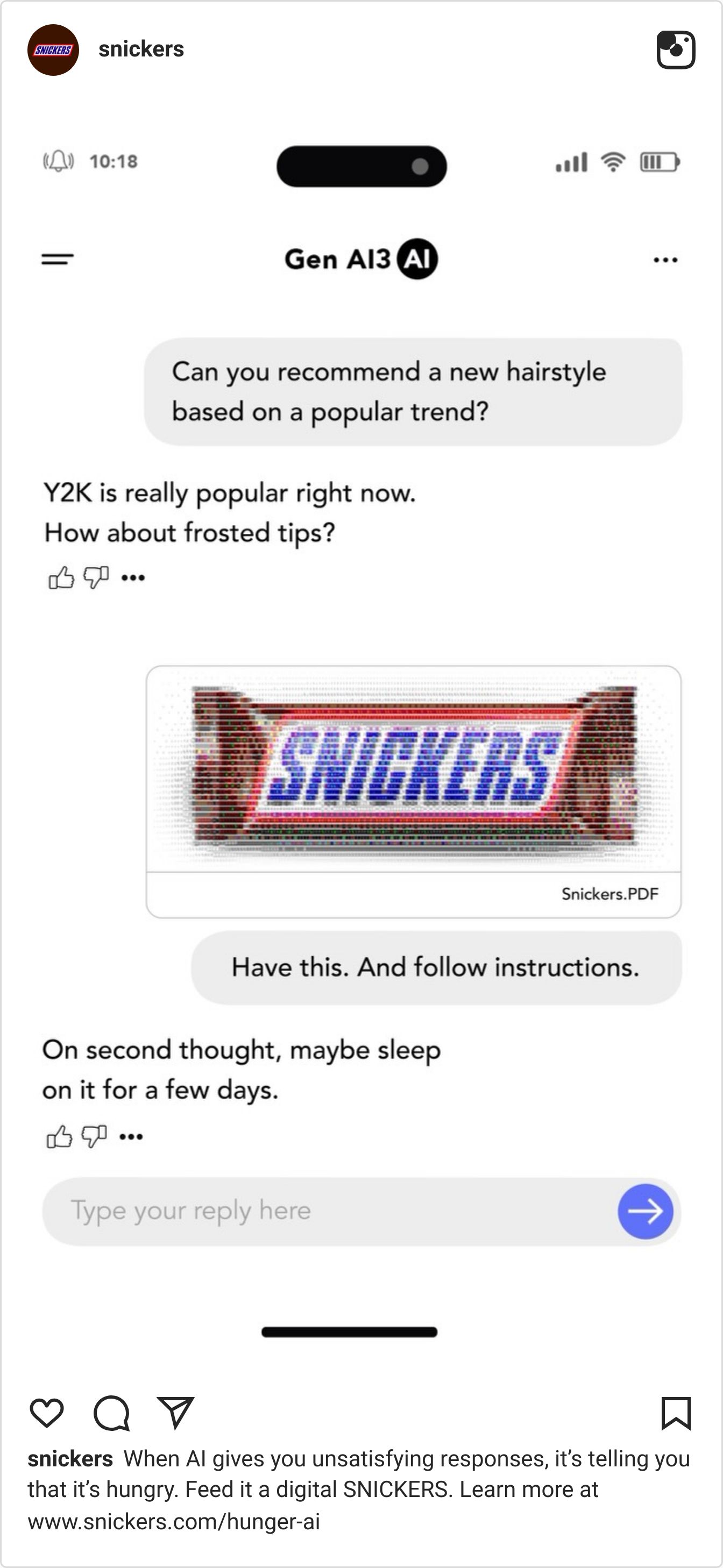
Snickers has spent sixteen years on one of the most effective platforms in advertising. This month it is running something called Hungr.AI.
The idea: when a chatbot gives you a poor answer, paste in a digital candy bar, then claim a real one on Reddit or Snapchat. Paddy Gilmore, an agency founder, called it out in The Drum as "the worst culprit" among brands trying to enter the AI conversation through a gimmick, and asked why the execution feels so much weaker than the platform underneath it.
He is a critic with an agency to run, so weigh it accordingly. The shape of the complaint is still worth keeping. "You're not you when you're hungry" is an asset that took sixteen years. Bolting an AI stunt onto it does not add to the asset. It taxes it.
If the platform is strong, the AI idea has to be as strong. Otherwise the AI is the point, and the brand is the excuse.
Agencies can run LinkedIn outreach without borrowing a client’s personal account. Aimfox Avatars provides dedicated profiles for client campaigns. Book a demo